Two market reports on Beacon Hill condos, drawn from the same stretch of 2026, reached opposite conclusions. One described a neighborhood where low inventory kept sellers firmly in control. The other, citing the same quarter, noted that months of supply had jumped 114 percent, tilting the balance toward buyers. Neither was wrong. They were just describing different rooms in the same house.
That is the problem with quoting a single median for Beacon Hill this year. The number technically exists, but it is doing the work of averaging two markets that are moving in opposite directions, on top of a price geography so uneven that a single zip code contains what amounts to two neighborhoods with a five-fold gap between them. If you are comparing Beacon Hill to Back Bay or the South End on the strength of a headline price, you are comparing an average to two other averages, and none of the three tells you what your specific budget will actually encounter.
A Median That Won't Sit Still
Start with how thin this market actually is. Ten condos and homes sold in Beacon Hill in January 2026, a 25 percent increase over the same month a year earlier, and the median sale price came in at $1.122 million. That figure included two high-profile closings, a unit at 32 West Cedar Street that traded for $4.8 million and one at 6 Strong Place for $3.1 million. Even with two multi-million-dollar sales in a pool of ten, the median barely moved past $1.1 million, which tells you most of what closed that month sat well below that line.
A month later, February's reported median jumped to roughly $1.81 million. Boston's Q1 2026 blended figure across the full quarter settled back down near $1.16 million, closer to January's number than February's. By the three months ending in May, the median had climbed to $1.3 million, up 8.4 percent year over year, with average days on market falling to 37 from 69 the year before.
None of these numbers are wrong. They are just measuring a market where 34 to 41 transactions can constitute an entire quarter or month of activity. When your sample size is that small, a handful of closings on Chestnut Street or Mt. Vernon Street can swing the median by hundreds of thousands of dollars without anything about "the market" actually changing. Treat any single month's median for Beacon Hill as a data point, not a forecast.
Two Tiers, Moving in Opposite Directions
The more useful split isn't month to month. It's price band. Beacon Hill in 2026 is really two markets stacked on top of each other, and they are behaving nothing alike.
| Price band | Recent behavior | What's driving it |
|---|---|---|
| Studios, $412K–$475K | Concentrated on Bowdoin and Beacon streets, moving quickly | Entry-level scarcity |
| 1-bedrooms, $630K–$1.155M | High demand for anything under $1M | Tight supply at the accessible end |
| 2-bedrooms, $850K–$2.5M | Averaged 39 to 59 days on market in Q1 2026, down from a 100-day average the year before | Competitive, though price varies sharply with elevator access and outdoor space |
| Luxury, $3M–$11M+ | Described as a slight inventory surplus against a competitive mid-market | Fewer qualified buyers at the top, more listings chasing them |
The mid-market condo, the one-bedroom under $1 million or the two-bedroom with parking, is still selling in the neighborhood of a month, sometimes faster. That segment's sale-to-list ratio ran about 95.8 percent in Q1 2026, which is not a discount market. Meanwhile the same quarter's data showed total months of supply rising to 4.89, a 114 percent jump, driven almost entirely by inventory sitting at the top of the price range. A market can be scarce and competitive at $900,000 and soft at $4 million at the exact same time, because those are functionally two different buyer pools competing for two different kinds of properties.
Three Slopes, One Zip Code
The price split by property type is only half the story. The other half is geography, and Beacon Hill's geography has been doing this same job since the neighborhood was built.
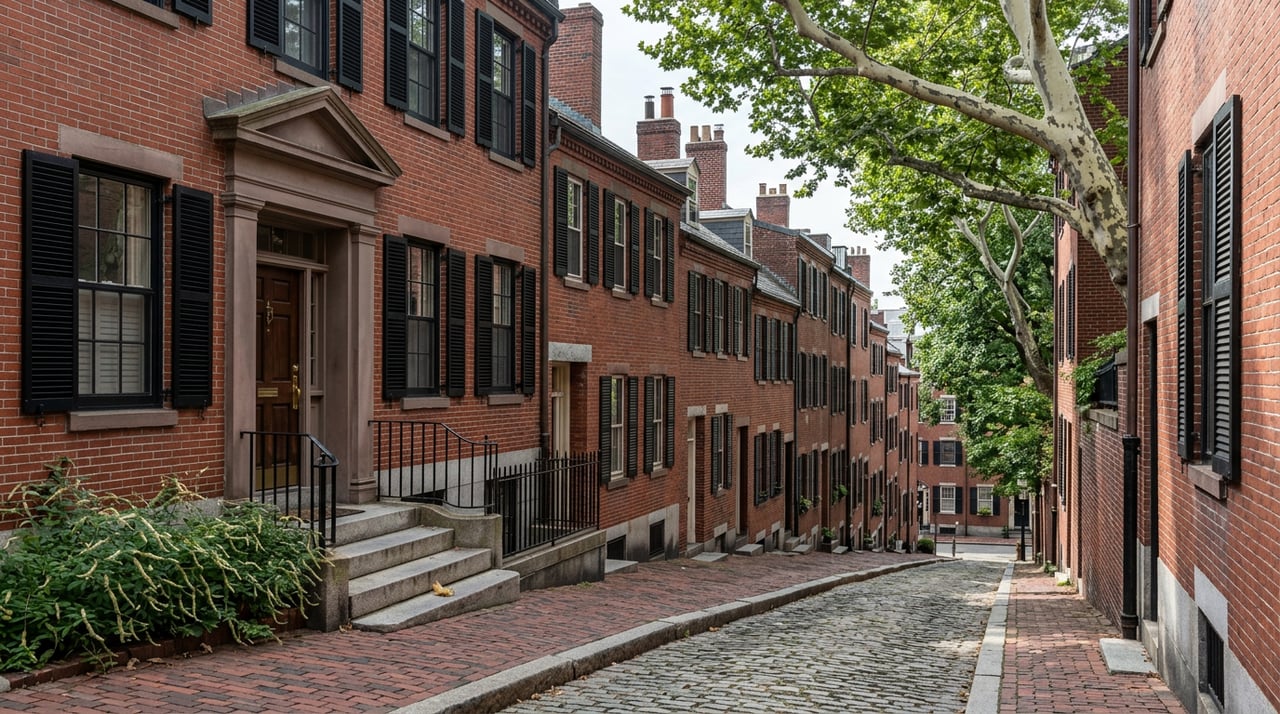
When the Mount Vernon Proprietors began developing the hill in 1795, they created three distinct sections: the South Slope, the North Slope, and the Flat of the Hill, land reclaimed by leveling the hill's original peaks and filling in part of the Charles River shoreline. Charles Bulfinch, one of the proprietors and the architect of several Beacon Hill houses, helped lay out the South Slope for the city's wealthiest families, with wider streets and setbacks that gave those houses room to breathe. The North Slope developed more organically, historically home to a free Black community, including formerly enslaved people who worked as domestic staff for South Slope households, and later to waves of Eastern and Southern European immigrants. The Flat of the Hill grew up around commerce, with Charles Street becoming the neighborhood's retail and dining spine, a role it still holds today.
That three-part structure never went away. It's still visible in the price data. A recent listing snapshot put the North Slope's median around $957,000 against a Flat of the Hill median near $4.89 million, inside a single reported neighborhood-wide listing median of roughly $1.2 million. A buyer using that $1.2 million figure to size up Beacon Hill is essentially averaging a starter one-bedroom against a full-floor Federal-era townhouse and calling the result representative of either one.
All three sections earned individual historic district status between 1955 and 1963, and the whole neighborhood became a National Historic Landmark in 1962, which is part of why the physical character that created this price split in the first place hasn't been allowed to change much since.
What's Softening at the Top
The luxury surplus shows up in specific, recent transactions, not just aggregate numbers. Within the Front Slope, the seven-street stretch of the South Slope considered the most prestigious pocket of the neighborhood, average price per square foot fell 16 percent year over year in a report published in early 2026, even as that pocket still accounted for roughly a quarter of Beacon Hill's total sales volume. The drop wasn't attributed to weak buyer interest. It came from the mix of what actually traded: oversized, historically significant properties that needed either serious renovation capital or a seller willing to price for that reality. One cited case, the sale of 44 Beacon Street at $823 per square foot, was framed less as an outlier than as a signal that buyers still want scale and provenance, but only at a price that accounts for the cost of owning and maintaining it.
That pattern lines up with what's happening in the luxury tier more broadly. Trophy-priced sales across Boston's premium neighborhoods reportedly fell around 35 percent in late 2025, and some developers and sellers have started offering closing-cost credits or condo-fee concessions to move units that would have found buyers instantly two years ago. Back Bay and Beacon Hill are still described as the most stable, prestigious addresses in the city, with overall inventory in these historic cores staying scarce. That scarcity claim and the luxury surplus claim aren't contradictory. There's genuinely little for sale in Beacon Hill at any given time, but a disproportionate share of what is on the market sits at the top of the price ladder, where the buyer pool is thinner and pickier.
What Your Budget Actually Buys You Here
If you're comparing Beacon Hill against other Boston neighborhoods using a single median, you're using the wrong tool. The better question is which of Beacon Hill's markets your number actually lands in.
Under roughly $1.2 million, you're in the North Slope's competitive band, up against other buyers, moving fast, and unlikely to find much room to negotiate on a well-priced one-bedroom or small two-bedroom. Between $1.2 million and $3 million, you're in genuinely contested territory where elevator access, private outdoor space, and floor level do more to determine your final price than the neighborhood label does. Above $3 million, you're shopping in a segment with real inventory and sellers who, this year, are more willing to talk about price, timeline, and what they'll cover at closing.
None of that shows up in a single quoted median. It shows up when you ask which slope, which price band, and which month's data you're actually looking at.
A Few Direct Questions
Is Beacon Hill a buyer's market or a seller's market right now? Both, depending on price point. Entry and mid-tier condos, generally under $1.5 million, are still moving quickly with limited room to negotiate. The segment above $3 million has more inventory and more seller flexibility than it did two years ago.
Why do the reported median prices swing so much from month to month? Because the sample size is small. With roughly 10 to 40 transactions closing in a given month, one or two high-value sales can shift the median by hundreds of thousands of dollars without reflecting a broader shift in value.
Does it matter which part of Beacon Hill I'm looking at? Significantly. Reported listing medians have run from roughly $957,000 on the North Slope to nearly $4.89 million on the Flat of the Hill, a gap wide enough that neither figure describes the other.
Numbers like these are a starting point, not a strategy. If you're trying to figure out where your specific budget actually lands on Beacon Hill, or how a property's slope, floor, and outdoor space should factor into what you offer, Penney + Gould can walk you through what the current data means for your search, street by street.